
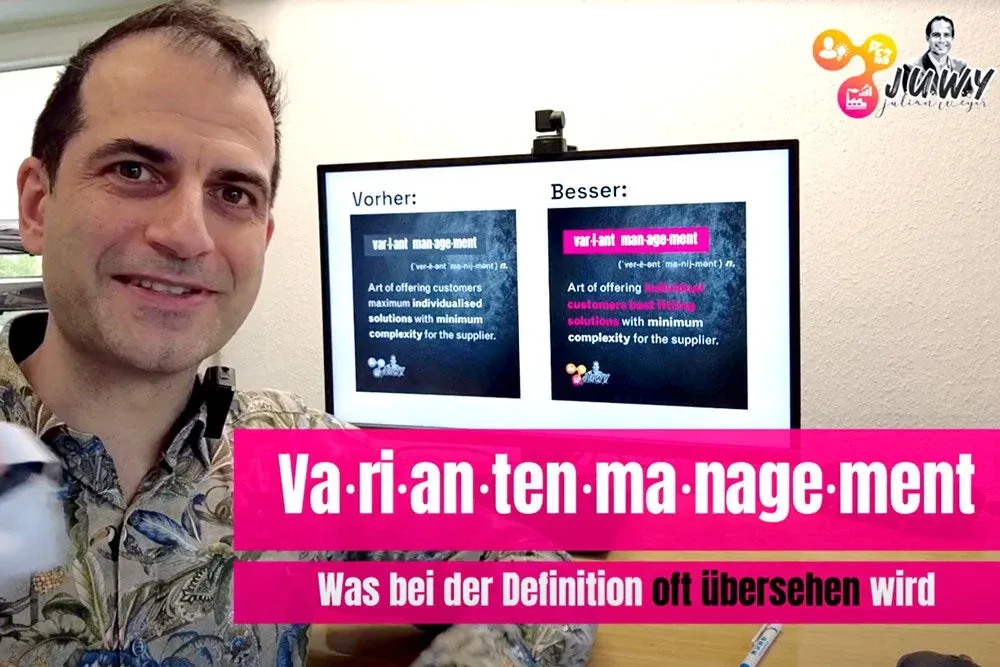

I like looking at definitions. Not out of academic interest, but because a good definition reveals how people really understand a topic, and where their blind spots are.
On the topic of variant management, I worked my way through a whole series of definitions. And I noticed something.
What most definitions emphasize
The emphasis is (far too) often on variant reduction or bringing variants under control. So anyone doing variant management is supposed to have as few variants as possible, and keep the remaining ones under control.
Sure, that’s part of it.
But that alone misses the actual purpose of variant management. At least, that’s my opinion.
Imagine a company that consistently reduces its variants until it finally offers only a single standard product. Internal complexity would be minimal. Is that perfect variant management? No. The company would simply have forgotten that customers have different needs.
The forgotten dimension: the customer
Variant management does not exist for its own sake. There is a reason why companies offer different products in the first place: customers want different things. One needs a bike for dirt roads, another for the city. One wants a vehicle with a tow bar, another with a big trunk. One needs a ventilator with this parameter set, another with that one.
Variants are not a burden to be got rid of as far as possible. They are the means by which a company serves different customers.
That does not mean complexity doesn’t matter. But it does mean that “fewer variants” is not a goal in itself. The real goal is a different one.
A definition that takes both sides seriously
So I developed a definition of my own:
Variant management is the art of offering different customers the optimal solution for each of them while keeping your own complexity to a minimum.
What matters here: both sides stand side by side as equals. Not “reduce variants,” but finding the optimum for the customer. And not “somehow cope with complexity,” but keeping it minimal.
This is a tension, not an equation. A company that only caters to customer wishes without managing complexity loses control of its own value creation. A company that only looks at internal efficiency eventually loses its customers.
Variant management is the discipline of balancing this tension. And that really is an art.
What this means in practice
The definition has consequences. If I truly understand variant management this way, it means:
- Variants should not simply be cut because they are expensive internally, without asking whether customers need them.
- New variants should not simply be introduced because a salesperson once won an interesting special order, without asking what complexity that creates in the long run.
- Variant management is not purely an engineering task. It is a strategic question that marketing, sales, development and production must answer together.
The common focus on variant reduction falls short. Properly understood, variant management is the balance between customer focus (optimal solutions for different customers) and internal efficiency (minimal complexity). Holding both dimensions together is the real task.
I’d be interested to hear: how do you define variant management in your company? And which dimension weighs more heavily for you? Feel free to write to me.
How I arrived at this definition
I also recorded the derivation, covering which existing definitions I looked at and why this particular aspect caught my eye, as a video: